
Class 10 Chapter 1 – Real Number Exercise 1.1 page number 7
1. Use Euclid’s division algorithm to find the HCF of:
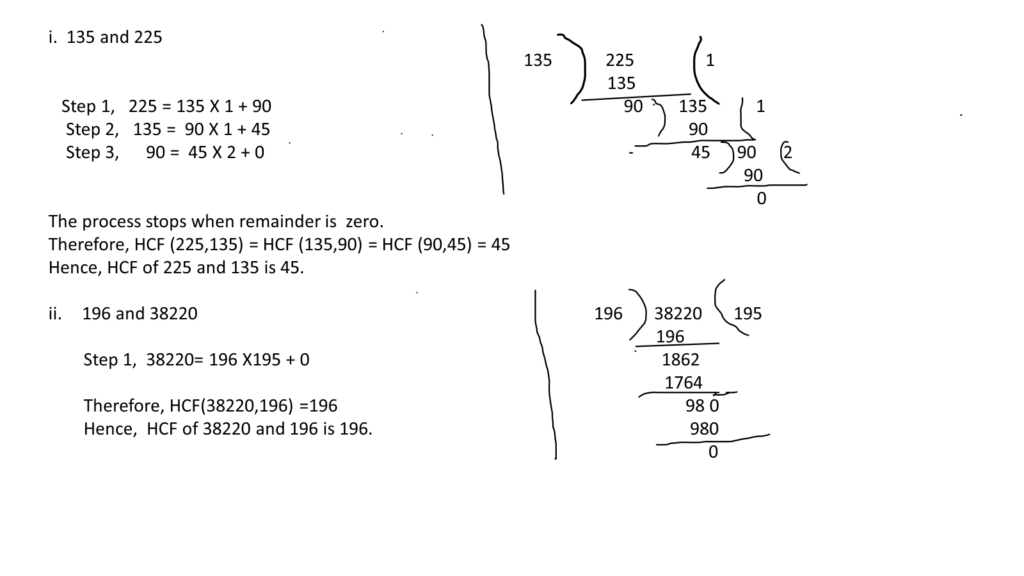
i. 135 and 225
ii. 196 and 38220
iii. 867 and 255
Solutions:
iii. 867 and 255
As we know, 867 is greater than 255. Let us now apply Euclid’s division algorithm on 867 to get
867 = 255 × 3 + 102
Remainder 102 ≠ 0; therefore, taking 255 as the divisor and applying the division lemma method, we get
255 = 102 × 2 + 51
Again, 51 ≠ 0. Now, 102 is the new divisor, so by repeating the same step, we get
102 = 51 × 2 + 0
The remainder is now zero, so our procedure stops here. In the last step, the divisor is 51; therefore, HCF (867,255) = HCF(255,102) = HCF(102,51) = 51
Hence, the HCF of 867 and 255 is 51.
2. Show that any positive odd integer is of form 6q + 1, or 6q + 3, or 6q + 5, where q is some integer.
Solution:
Let a be any positive integer and b = 6. Then, by Euclid’s algorithm, a = 6q + r, for some integer q ≥ 0, and r = 0, 1, 2, 3, 4, 5, because 0≤r<6.
Now, substituting the value of r, we get
If r = 0, then a = 6q
Similarly, for r= 1, 2, 3, 4 and 5, the value of a is 6q+1, 6q+2, 6q+3, 6q+4 and 6q+5, respectively.
If a = 6q, 6q+2, 6q+4, then a is an even number and divisible by 2. A positive integer can be either even or odd Therefore, any positive odd integer is of the form of 6q+1, 6q+3 and 6q+5, where q is some integer.
3. An army contingent of 616 members is to march behind an army band of 32 members in a parade. The two groups are to march in the same number of columns. What is the maximum number of columns in which they can march?
Solution:
Given,
Number of army contingent members=616
Number of army band members = 32
If the two groups have to march in the same column, we have to find out the highest common factor between the two groups. HCF (616, 32) gives the maximum number of columns in which they can march.
By Using Euclid’s algorithm to find their HCF, we get
Since 616>32, therefore,
616 = 32 × 19 + 8
Since 8 ≠ 0, therefore, taking 32 as the new divisor, we have
32 = 8 × 4 + 0
Now, we have the remainder as 0; therefore, HCF (616, 32) = 8
Hence, the maximum number of columns in which they can march is 8.
4. Use Euclid’s division lemma to show that the square of any positive integer is either of form 3m or 3m + 1 for some integer m.
Solutions:
Let x be any positive integer and y = 3.
By Euclid’s division algorithm, then
x = 3q + r for some integer q≥0 and r = 0, 1, 2, as r ≥ 0 and r < 3
Therefore, x = 3q, 3q+1 and 3q+2
Now, as per the question given, by squaring both sides, we get
x2 = (3q)2 = 9q2 = 3 × 3q2
Let 3q2 = m
Therefore, x2= 3m ……………………..(1)
x2 = (3q + 1)2 = (3q)2+12+2×3q×1 = 9q2 + 1 +6q = 3(3q2+2q) +1
Substitute 3q2+2q = m to get
x2= 3m + 1 ……………………………. (2)
x2= (3q + 2)2 = (3q)2+22+2×3q×2 = 9q2 + 4 + 12q = 3 (3q2 + 4q + 1)+1
Again, substitute 3q2+4q+1 = m to get
x2= 3m + 1…………………………… (3)
Hence, from equations 1, 2 and 3, we can say that the square of any positive integer is either of form 3m or 3m + 1 for some integer m.
5. Use Euclid’s division lemma to show that the cube of any positive integer is of the form 9m, 9m + 1 or 9m + 8.
Solution:
Let x be any positive integer and y = 3.
By Euclid’s division algorithm, then
x = 3q+r, where q≥0 and r = 0, 1, 2, as r ≥ 0 and r < 3.
Therefore, putting the value of r, we get
x = 3q
or
x = 3q + 1
or
x = 3q + 2
Now, by taking the cube of all the three above expressions, we get
Case (i): When r = 0, then,
x2= (3q)3 = 27q3= 9(3q3)= 9m; where m = 3q3
Case (ii): When r = 1, then,
x3 = (3q+1)3 = (3q)3 +13+3×3q×1(3q+1) = 27q3+1+27q2+9q
Taking 9 as a common factor, we get
x3 = 9(3q3+3q2+q)+1
Putting = m, we get
Putting (3q3+3q2+q) = m, we get
x3 = 9m+1
Case (iii): When r = 2, then,
x3 = (3q+2)3= (3q)3+23+3×3q×2(3q+2) = 27q3+54q2+36q+8
Taking 9 as a common factor, we get
x3=9(3q3+6q2+4q)+8
Putting (3q3+6q2+4q) = m, we get
x3 = 9m+8
Therefore, from all the three cases explained above, it is proved that the cube of any positive integer is of the form 9m, 9m + 1 or 9m + 8.
Exercise 1.1 of NCERT Solutions for Class 10 Maths Chapter 1 Real Numbers is the first exercise of Chapter 1 of Class 10 Maths. Real Numbers are introduced in Class 9 and are discussed further in detail in Class 10 by studying Euclid’s division Algorithm. The exercise discusses the divisibility of integers. The divisibility of integers using Euclid’s division algorithm says that any positive integer a can be divided by another positive integer b, such that the remainder will be which is small