
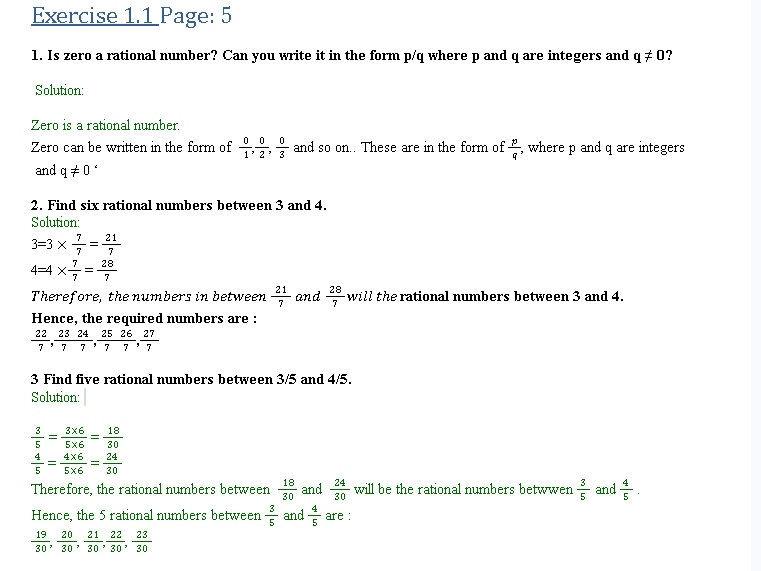
1. Is zero a rational number? Can you write it in the form p/q where p and q are integers and q ≠ 0?
Solution:
Zero is a rational number.
Zero can be written in the form of 01,02, 03 and so on.. These are in the form of pq, where p and q are integers
and q ≠ 0 ‘
2. Find six rational numbers between 3 and 4.
Solution:
3=3 77 = 217
4=4 77 = 287
Therefore, the numbers in between 217 and 287will the rational numbers between 3 and 4.
Hence, the required numbers are :
227,237247,257267,277
3 Find five rational numbers between 3/5 and 4/5.
Solution:
35 = 3656 = 1830
45 = 4656 = 2430
Therefore, the rational numbers between 1830 and 2430 will be the rational numbers betwwen 35 and 45 .
Hence, the 5 rational numbers between 35 and 45 are :
1930, 2030, 2130,2230, 2330
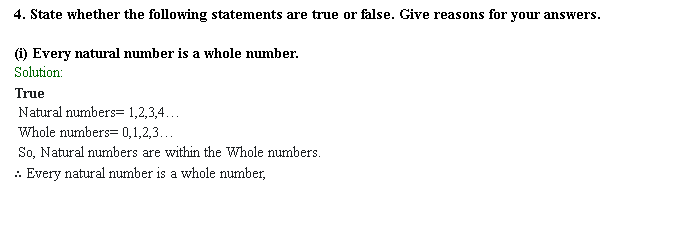
4. State whether the following statements are true or false. Give reasons for your answers.
(i) Every natural number is a whole number.
Solution:
True
Natural numbers= 1,2,3,4…
Whole numbers= 0,1,2,3…
So, Natural numbers are within the Whole numbers.
∴ Every natural number is a whole number,
NCERT Solutions for Class 9 Maths Chapter 1- Number System
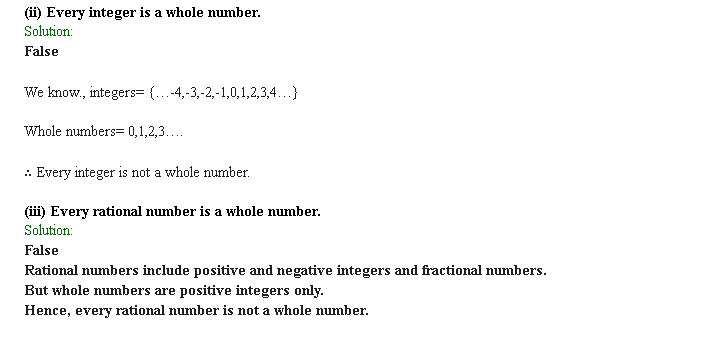
(ii) Every integer is a whole number.
Solution:
False
We know., integers= {…-4,-3,-2,-1,0,1,2,3,4…}
Whole numbers= 0,1,2,3….
∴ Every integer is not a whole number.
(iii) Every rational number is a whole number.
Solution:
False
Rational numbers include positive and negative integers and fractional numbers.
But whole numbers are positive integers only.
Hence, every rational number is not a whole number.
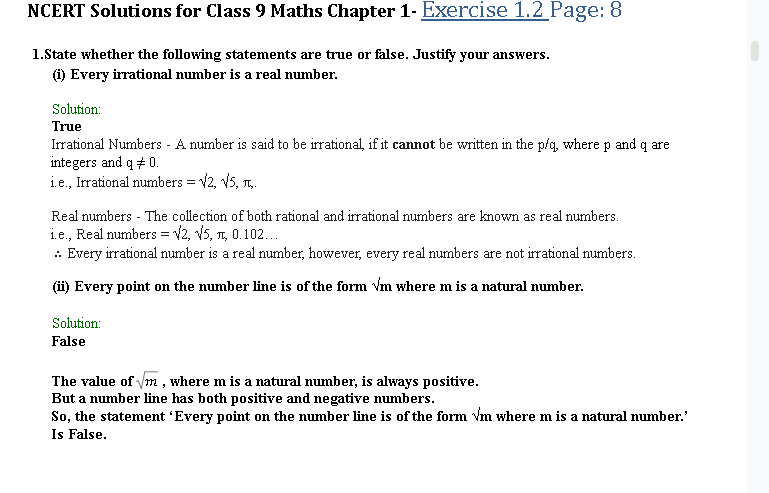
CERT Solutions for Class 9 Maths Chapter 1- Number System Exercise 1.2 Page: 8
1.State whether the following statements are true or false. Justify your answers.
(i) Every irrational number is a real number.
Solution:
True
Irrational Numbers – A number is said to be irrational, if it cannot be written in the p/q, where p and q are integers and q ≠ 0.
i.e., Irrational numbers = √2, √5, π,.
Real numbers – The collection of both rational and irrational numbers are known as real numbers. i.e., Real numbers = √2, √5, π, 0.102…
∴ Every irrational number is a real number, however, every real numbers are not irrational numbers. (ii) Every point on the number line is of the form √m where m is a natural number.
Solution:
False
The value of m , where m is a natural number, is always positive.
But a number line has both positive and negative numbers.
So, the statement ‘Every point on the number line is of the form √m where m is a natural number.’
Is False.
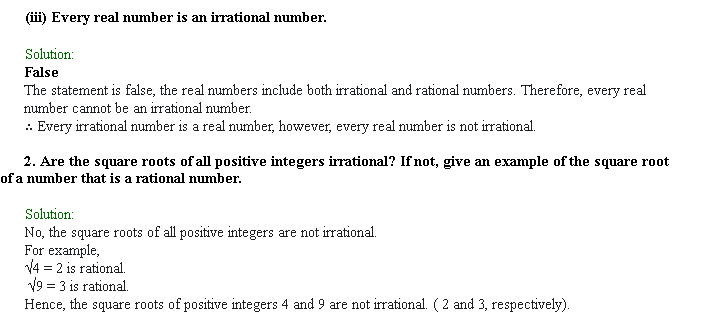
(iii) Every real number is an irrational number.
Solution:
False
The statement is false, the real numbers include both irrational and rational numbers. Therefore, every real number cannot be an irrational number.
∴ Every irrational number is a real number, however, every real number is not irrational.
2. Are the square roots of all positive integers irrational? If not, give an example of the square root of a number that is a rational number.
Solution:
No, the square roots of all positive integers are not irrational.
For example,
√4 = 2 is rational.
√9 = 3 is rational.
Hence, the square roots of positive integers 4 and 9 are not irrational. ( 2 and 3, respectively).
NCERT Solutions for Class 9 Maths Chapter 1- Number System
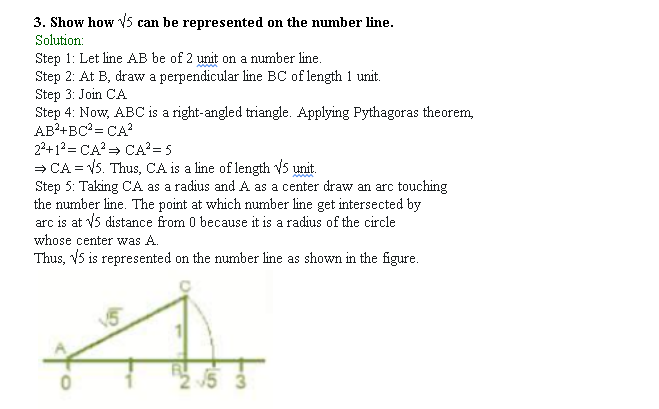
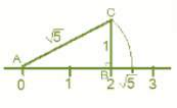
3. Show how √5 can be represented on the number line.
Solution:
Step 1: Let line AB be of 2 unit on a number line.
Step 2: At B, draw a perpendicular line BC of length 1 unit.
Step 3: Join CA
Step 4: Now, ABC is a right-angled triangle. Applying Pythagoras theorem,
AB2+BC2 = CA2
22+12 = CA2 ⇒ CA2 = 5
⇒ CA = √5. Thus, CA is a line of length √5 unit.
Step 5: Taking CA as a radius and A as a center draw an arc touching
the number line. The point at which number line get intersected by
arc is at √5 distance from 0 because it is a radius of the circle
whose center was A.
Thus, √5 is represented on the number line as shown in the figure.
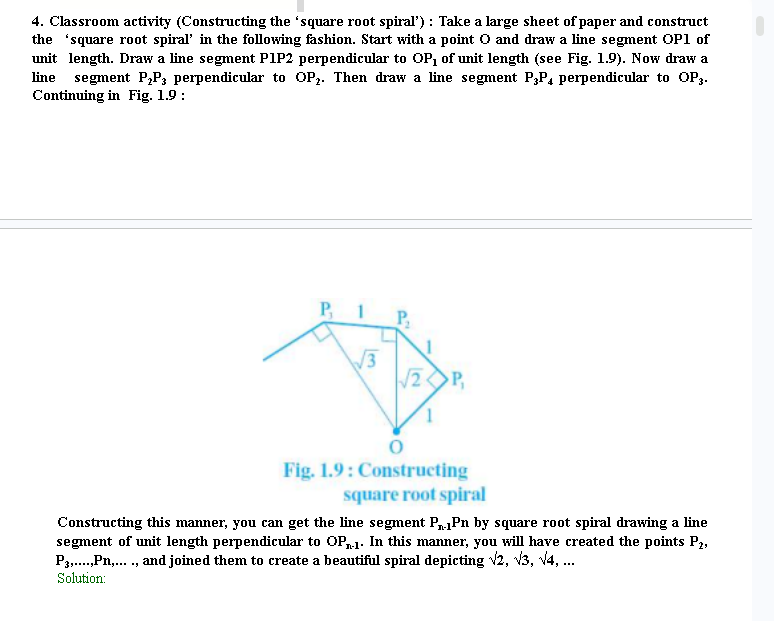
4. Classroom activity (Constructing the ‘square root spiral’) : Take a large sheet of paper and construct the ‘square root spiral’ in the following fashion. Start with a point O and draw a line segment OP1 of unit length. Draw a line segment P1P2 perpendicular to OP1 of unit length (see Fig. 1.9). Now draw a line segment P2P3 perpendicular to OP2. Then draw a line segment P3P4 perpendicular to OP3. Continuing in Fig. 1.9 :
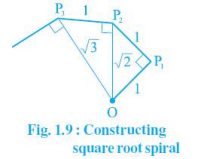
Constructing this manner, you can get the line segment Pn-1Pn by square root spiral drawing a line segment of unit length perpendicular to OPn-1. In this manner, you will have created the points P2, P3,….,Pn,… ., and joined them to create a beautiful spiral depicting √2, √3, √4, …
Solution:
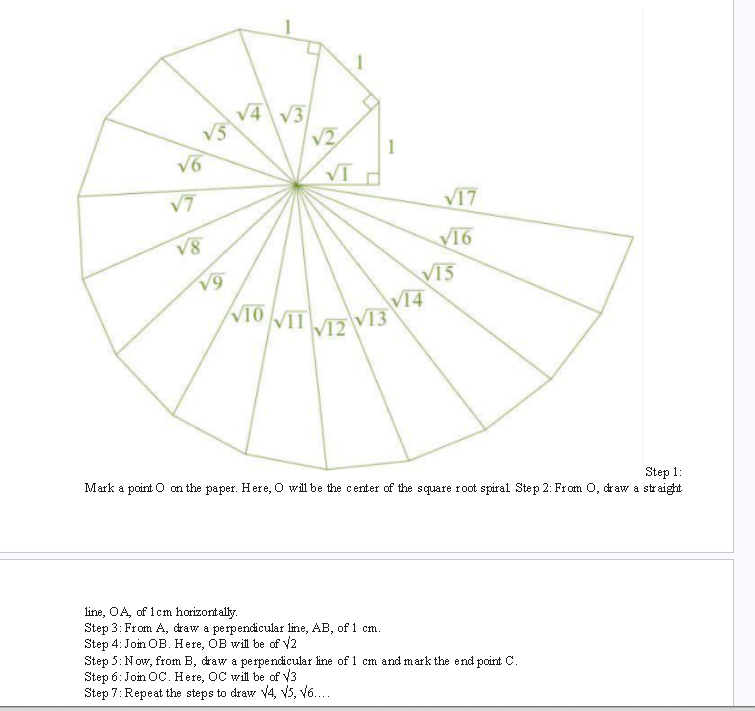
NCERT Solutions for Class 9 Maths Chapter 1- Number System Step 1: Mark a point O on the paper. Here, O will be the center of the square root spiral. Step 2: From O, draw a straight line, OA, of 1cm horizontally.
Step 3: From A, draw a perpendicular line, AB, of 1 cm.
Step 4: Join OB. Here, OB will be of √2
Step 5: Now, from B, draw a perpendicular line of 1 cm and mark the end point C.
Step 6: Join OC. Here, OC will be of √3
Step 7: Repeat the steps to draw √4, √5, √6….
NCERT Solutions for Class 9 Maths Chapter 1- Number System
Exercise 1.3 Page: 14
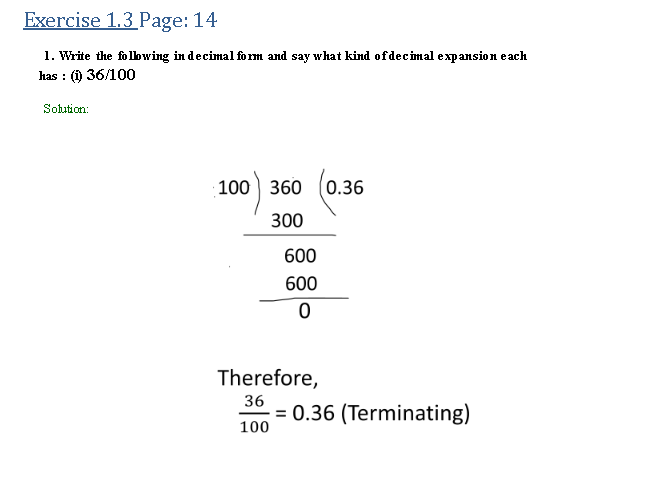
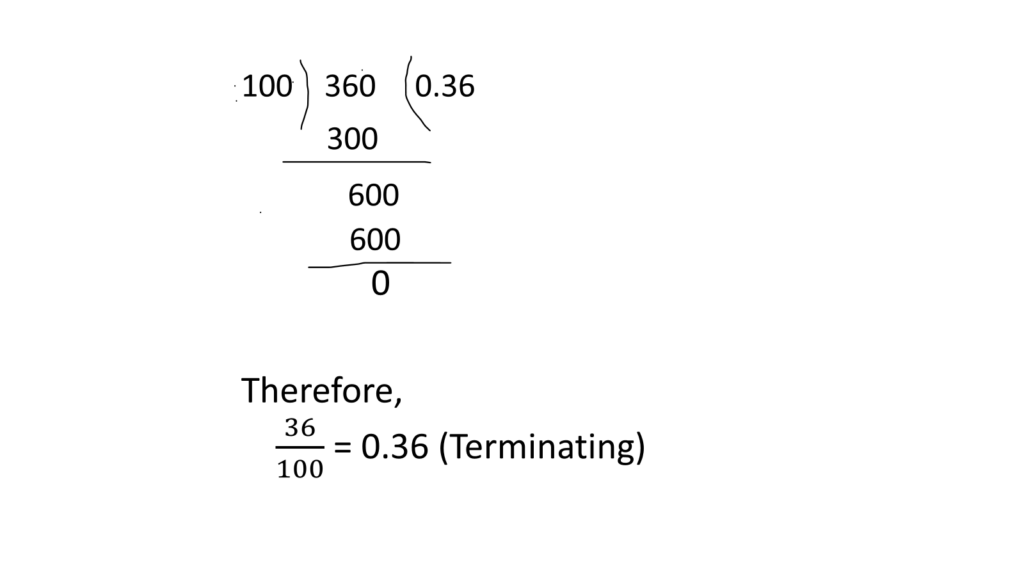
1. Write the following in decimal form and say what kind of decimal expansion each has : (i) 36/100
Solution:
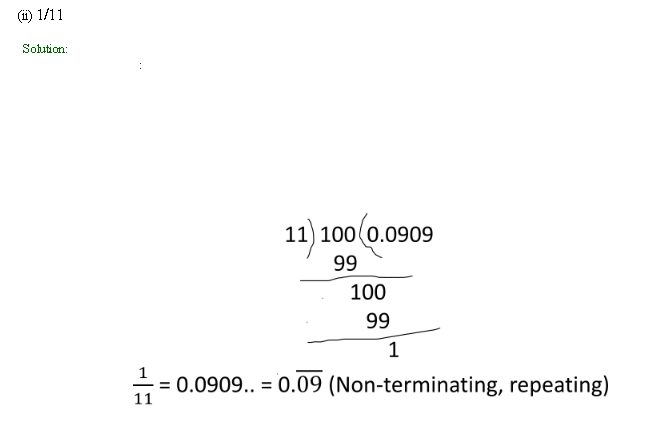
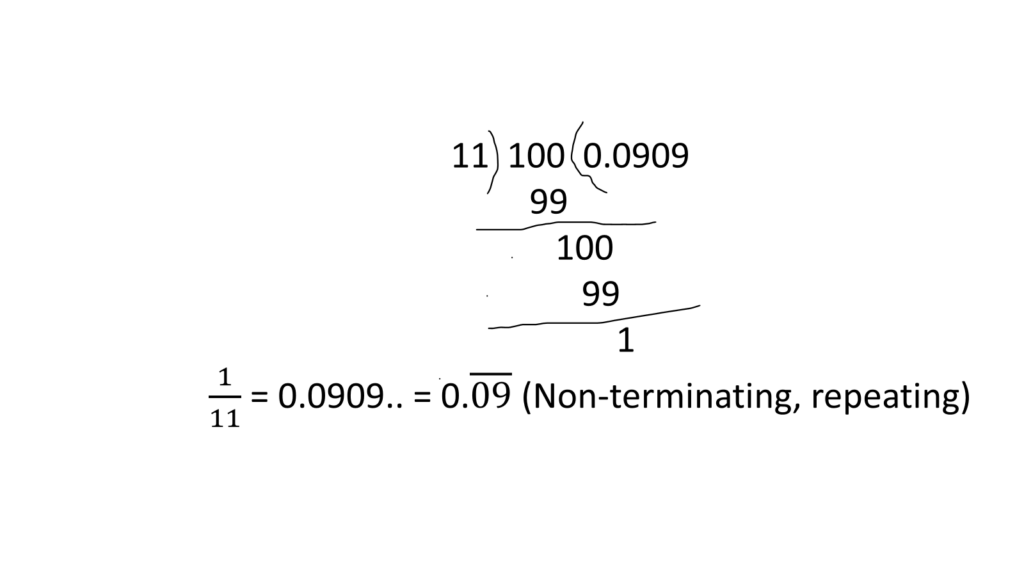
(ii) 1/11
Solution:
:
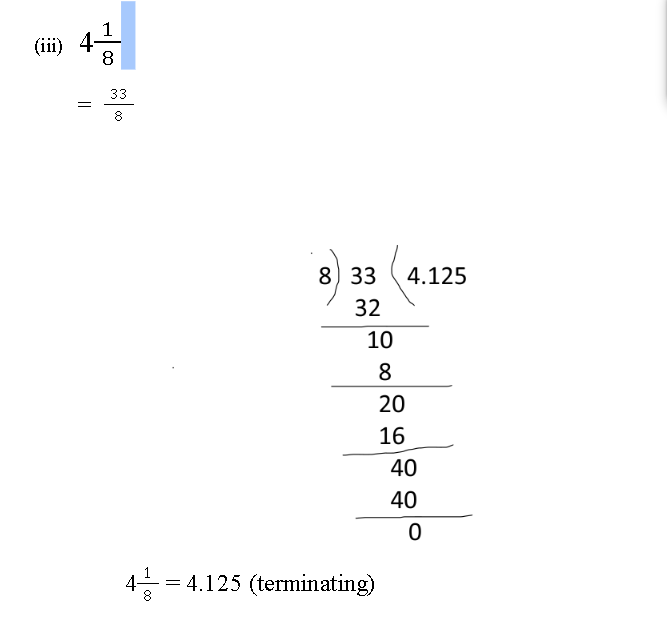
(iii) 418
= 338
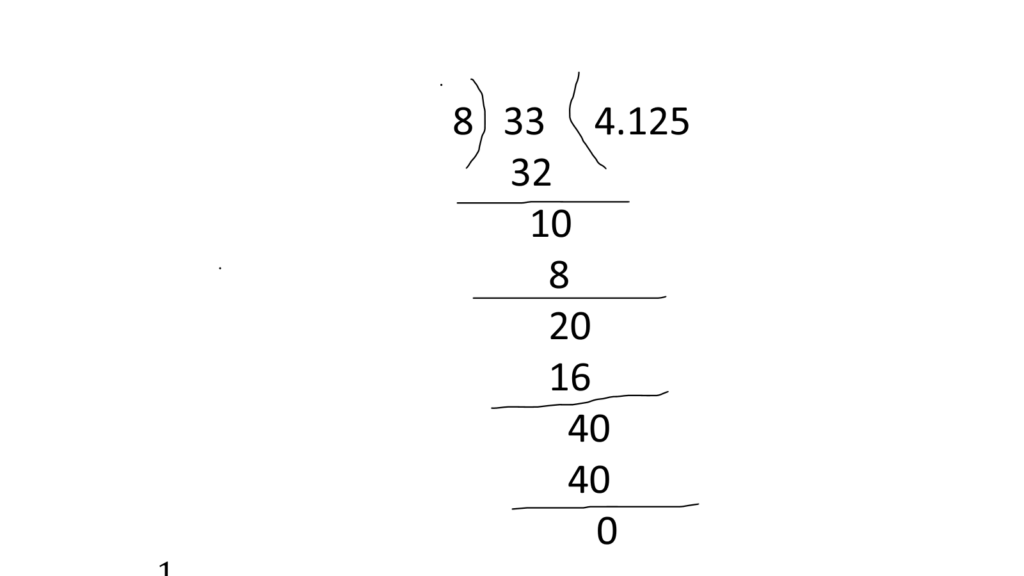
418 = 4.125 (terminating)
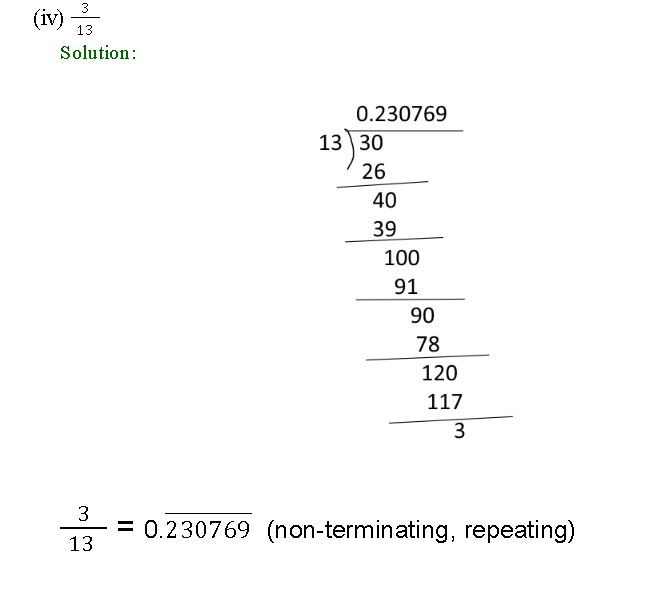
(iv) 313
Solution:
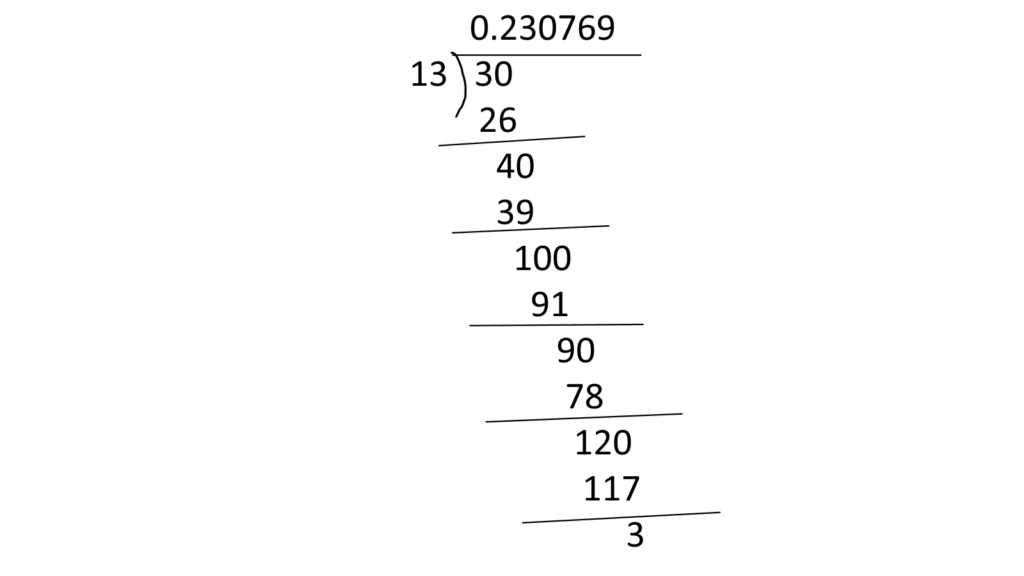
313 = 0.230769 (non-terminating, repeating)
(iv)2/11
Solution:
0.18
11 2
0
20
11
90
88
2
(iv) 329/400
NCERT Solutions for Class 9 Maths Chapter 1- Number System
Solution:
0.8225
400 329
0
3290
3200
900
800
1000
800
2000
2000
0
= 0.8225 (Terminating)
2. You know that 1/7 = 0.142857. Can you predict what the decimal expansions of 2/7, 3/7, 4/7, 5/7, 6/7 are, without actually doing the long division? If so, how?
[Hint: Study the remainders while finding the value of 1/7 carefully.]
Solution:
3. Express the following in the form p/q, where p and q are integers and q ≠ 0.
(i)
Solution:
Assume that x = 0.666…
Then,10x = 6.666…
10x = 6 + x
9x = 6
x = 2/3
Solution:
NCERT Solutions for Class 9 Maths Chapter 1- Number System
= (4/10) + (0.777…./10)
Assume that x = 0.777…
Then, 10x = 7.777…
10x = 7 + x
x = 7/9
(4/10)+(0.777../10) = (4/10)+(7/90) (∴ x = 7/9 and x = 0.777…⇒0.777…/10 = 7/(9×10) = 7/90) = (36/90)+(7/90) = 43/90
(iii)
Solution:
Assume that x = 0.001001…
Then, 1000x = 1.001001…
1000x = 1 + x
999x = 1
x = 1/999
4. Express 0.99999…. in the form p/q . Are you surprised by your answer? With your teacher and classmates discuss why the answer makes sense.
Solution:
Assume that x = 0.9999….. Eq (a)
Multiplying both sides by 10,
10x = 9.9999…. Eq. (b)
Eq.(b) – Eq.(a), we get
10x = 9.9999…
– x = – 0.9999…
9x = 9
x = 1
The difference between 1 and 0.999999 is 0.000001 which is negligible.
Hence, we can conclude that, 0.999 is too much near 1, therefore, 1 as the answer can be justified.
5. What can the maximum number of digits be in the repeating block of digits in the decimal expansion of 1/17? Perform the division to check your answer.
Solution:
1/17
Dividing 1 by 17:
NCERT Solutions for Class 9 Maths Chapter 1- Number System
0.0588235294117647
17 1
0
10
0
100
85
150
136
140
136
40
34
60
51
90
85
50
34
160
153
70
68
20
17
30
17
130
119
110
102
80
68
120
119
1
∴ There are 16 digits in the repeating block of the decimal expansion of 1/17.
NCERT Solutions for Class 9 Maths Chapter 1- Number System
6. Look at several examples of rational numbers in the form p/q (q ≠ 0), where p and q are integers with no common factors other than 1 and having terminating decimal representations (expansions). Can you guess what property q must satisfy?
Solution:
We observe that when q is 2, 4, 5, 8, 10… Then the decimal expansion is terminating. For example: 1/2 = 0. 5, denominator q = 21
7/8 = 0. 875, denominator q =23
4/5 = 0. 8, denominator q = 51
We can observe that the terminating decimal may be obtained in the situation where prime factorization of the denominator of the given fractions has the power of only 2 or only 5 or both.
7. Write three numbers whose decimal expansions are non-terminating non-recurring. Solution:
We know that all irrational numbers are non-terminating non-recurring. ∴ three numbers with decimal expansions that are non-terminating non-recurring are:
a) √3 = 1.732050807568
b) √26 = 5.099019513592
c) √101 = 10.04987562112
8. Find three different irrational numbers between the rational numbers 5/7 and 9/11.
Solution:
∴ Three different irrational numbers are:
a) 0.73073007300073000073…
b) 0.75075007300075000075…
c) 0.76076007600076000076…
9. Classify the following numbers as rational or irrational according to their type:
(i)√23
Solution:
√23 = 4.79583152331…
Since the number is non-terminating non-recurring therefore, it is an irrational number.
(ii)√225
NCERT Solutions for Class 9 Maths Chapter 1- Number System Solution:
√225 = 15 = 15/1
Since the number can be represented in p/q form, it is a rational number.
(i) 0.3796
Solution:
Since the number,0.3796, is terminating, it is a rational number.
(ii) 7.478478
Solution:
The number,7.478478, is non-terminating but recurring, it is a rational number.
(iii) 1.101001000100001…
Solution:
Since the number,1.101001000100001…, is non-terminating non-repeating (non-recurring), it is an irrational number.
NCERT Solutions for Class 9 Maths Chapter 1- Number System
Exercise 1.4 Page: 18
1. Visualise 3.765 on the number line, using successive magnification.
Solution:
NCERT Solutions for Class 9 Maths Chapter 1- Number System
NCERT Solutions for Class 9 Maths Chapter 1- Number System
Exercise 1.5 Page: 24
1. Classify the following numbers as rational or irrational:
(i)2 –√5
Solution:
We know that, √5 = 2.2360679…
Here, 2.2360679…is non-terminating and non-recurring.
Now, substituting the value of √5 in 2 –√5, we get,
2-√5 = 2-2.2360679… = -0.2360679
Since the number, – 0.2360679…, is non-terminating non-recurring, 2 –√5 is an irrational number.
(ii)(3 +√23) – √23
Solution:
(3 +√23) –√23 = 3+√23–√23
= 3
= 3/1
Since the number 3/1 is in p/q form, (3 +√23)- √23 is rational.
(iii)2√7/7√7
Solution:
2√7/7√7 = (2/7)× (√7/√7)
We know that (√7/√7) = 1
Hence, (2/7)× (√7/√7) = (2/7)×1 = 2/7
Since the number, 2/7 is in p/q form, 2√7/7√7 is rational.
(iv)1/√2
Solution:
Multiplying and dividing numerator and denominator by √2 we get,
(1/√2) ×(√2/√2)= √2/2 ( since √2×√2 = 2)
We know that, √2 = 1.4142…
Then, √2/2 = 1.4142/2 = 0.7071..
Since the number, 0.7071..is non-terminating non-recurring, 1/√2 is an irrational number.
(v)2π
Solution:
We know that, the value of π = 3.1415
Hence, 2π = 2×3.1415.. = 6.2830…
Since the number, 6.2830…, is non-terminating non-recurring, 2π is an irrational number.
2. Simplify each of the following expressions:
(i) (3+√3)(2+√2)
Solution:
NCERT Solutions for Class 9 Maths Chapter 1- Number System
(3+√3)(2+√2 )
Opening the brackets, we get, (3×2)+(3×√2)+(√3×2)+(√3×√2)
= 6+3√2+2√3+√6
(ii) (3+√3)(2+√2 )
Solution:
(3+√3)(2+√2 ) = 32-(√3)2 = 9-3
= 6
(iii) (√5+√2)2
Solution:
(√5+√2)2 = √52+(2×√5×√2)+ √22
= 5+2×√10+2 = 7+2√10
(iv) (√5-√2)(√5+√2)
Solution:
(√5-√2)(√5+√2) = (√52-√22) = 5-2 = 3
3. Recall, π is defined as the ratio of the circumference (say c) of a circle to its diameter, (say d). That is, π =c/d. This seems to contradict the fact that π is irrational. How will you resolve this contradiction?
Solution:
There is no contradiction. When we measure a value with a scale, we only obtain an approximate value. We never obtain an exact value. Therefore, we may not realize whether c or d is irrational. The value of π is almost equal to 22/7 or 3.142857…
4. Represent (√9.3) on the number line.
Solution:
Step 1: Draw a 9.3 units long line segment, AB. Extend AB to C such that BC=1 unit.
Step 2: Now, AC = 10.3 units. Let the centre of AC be O.
Step 3: Draw a semi-circle of radius OC with centre O.
Step 4: Draw a BD perpendicular to AC at point B intersecting the semicircle at D. Join OD. Step 5: OBD, obtained, is a right angled triangle.
Here, OD 10.3/2 (radius of semi-circle), OC = 10.3/2 , BC = 1
OB = OC – BC
⟹ (10.3/2)-1 = 8.3/2
Using Pythagoras theorem,
We get,
OD2= BD2+OB2
⟹ (10.3/2)2 = BD2+(8.3/2)2
⟹ BD2 = (10.3/2)2-(8.3/2)2
⟹ (BD)2 = (10.3/2)-(8.3/2)(10.3/2)+(8.3/2)
⟹ BD2 = 9.3
⟹ BD = √9.3
Thus, the length of BD is √9.3 units.
Step 6: Taking BD as radius and B as centre draw an arc which touches the line segment. The point where it touches the line segment is at a distance of √9.3 from O as shown in the figure.
NCERT Solutions for Class 9 Maths Chapter 1- Number System
5. Rationalize the denominators of the following:
(i) 1/√7
Solution:
Multiply and divide 1/√7 by √7
(1×√7)/(√7×√7) = √7/7
(ii) 1/(√7-√6)
Solution:
Multiply and divide 1/(√7-√6) by (√7+√6)
[1/(√7-√6)]×(√7+√6)/(√7+√6) = (√7+√6)/(√7-√6)(√7+√6)
= (√7+√6)/√72-√62 [denominator is obtained by the property, (a+b)(a-b) = a2-b2]
= (√7+√6)/(7-6)
= (√7+√6)/1
= √7+√6
(iii) 1/(√5+√2)
Solution:
Multiply and divide 1/(√5+√2) by (√5-√2)
[1/(√5+√2)]×(√5-√2)/(√5-√2) = (√5-√2)/(√5+√2)(√5-√2)
= (√5-√2)/(√52-√22) [denominator is obtained by the property, (a+b)(a-b) = a2-b2]
= (√5-√2)/(5-2)
= (√5-√2)/3
(iv)1/(√7-2)
Solution:
Multiply and divide 1/(√7-2) by (√7+2)
1/(√7-2)×(√7+2)/(√7+2) = (√7+2)/(√7-2)(√7+2)
= (√7+2)/(√72-22) [denominator is obtained by the property, (a+b)(a-b) = a2-b2]
= (√7+2)/(7-4)
= (√7+2)/3
NCERT Solutions for Class 9 Maths Chapter 1- Number System
Exercise 1.6 Page: 26
1. Find:
(i) 6412
Solution:
6412= (88)12
= (82)12
= 8(212)
= 81
= 8
(ii) 3215
Solution:
3215= = (25)15
= 2(515)
= 21
= 2
(iii) 12513
Solution:
(125)13 = (5×5×5)13
= (53)13
= 5(313)
= 51
= 5
2. Find:
(i)932
Solution:
932 = (3×3)32
= (32)32
=3(232)
=33
= 27
(ii)3225
Solution:
3225 = (2×2×2×2×2)25
= (25)25
= 2(525)
= 22
= 4
(iii)1634
Solution:
1634 = (2×2×2×2)34
= (24)34
= 2(434)
= 23
= 8
NCERT Solutions for Class 9 Maths Chapt er 1- Number System
(iv) 125-1/3
125-1/3 = (5×5×5)-1/3
= (53)-1⁄3
= 5-1[3×-1/3 = -1]
= 1/5
3. Simplify:
(i) 22/3×21/5
Solution:
22/3×21/5 = 2(2/3)+(1/5) [Since, am×an=am+n____ Laws of exponents]
= 213/15 [2/3 + 1/5 = (2×5+3×1)/(3×5) = 13/15]
(ii) (1/33)7
Solution:
(1/33)7 = (3-3)7 [Since,(am)n = am x n____ Laws of exponents]
= 3-27
(iii)111/2/111/4
Solution:
111/2/111/4 = 11(1/2)-(1/4)
= 111/4 [(1/2) – (1/4) = (1×4-2×1)/(2×4) = 4-2)/8 = 2/8 = ¼ ]
(iv)71/2×81/2
Solution:
71/2×81/2 = (7×8)1/2 [Since, (am×bm = (a×b)m ____ Laws of exponents
= 561/2